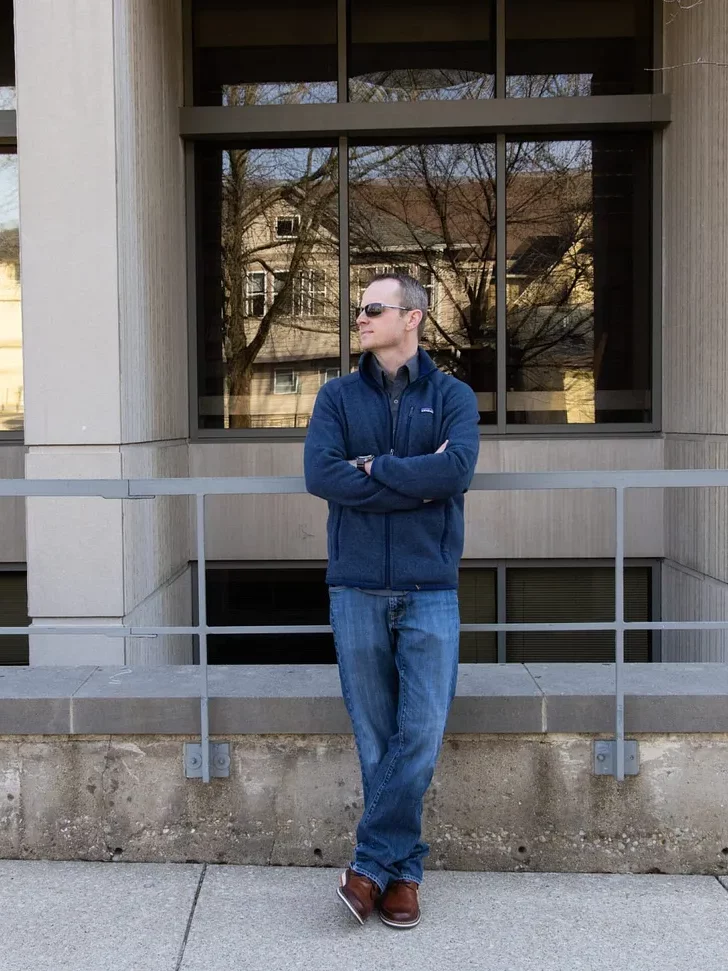
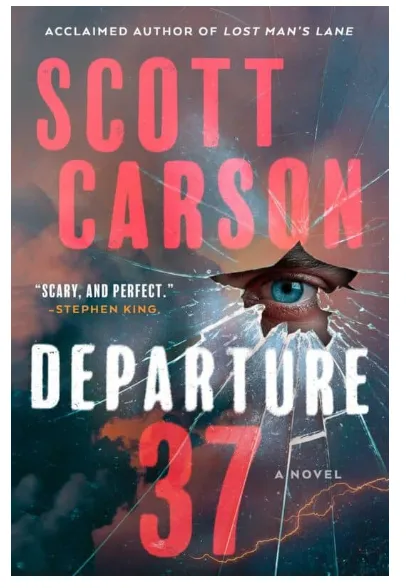
I’ve known Michael Koryta for almost 20 years and he has read more terrible drafts of my attempts at a PI novel than anyone not related to me should ever have to read. He is one of the most generous and supportive writers in a community known for pretty generous and supportive authors. He’s never blown up as big as I think he should, but he continues to publish novels year after year with incredible consistency and brilliance. This was rewarded last year with a nomination for Best Novel Edgar for AN HONEST MAN. He’s also unleashed his horror writing passion in the guise of Scott Carson whose lasted book in DEPARTURE 37.
Michael and I both share a love of the Paris Review interview series, so when I decided I wanted to start something similar in this newsletter he was the first person I thought of. And since his latest book is from his horror-tinged alias, launching this on Halloween seemed perfect. If you enjoy this interview, I have interviews with Lori Rader-Day, J. Todd Scott, and Eli Cranor (whose excellent Shop Talk interview series was a strong influence on this series) coming up.
This interview was conducted over Google Docs and has only been lightly edited for formatting.
BQ: Your origins as a writer are in journalism and private investigation at an uncommonly young age (bet you never get sick of hearing that). How did the twin apprenticeships of reporting facts and uncovering secrets shape your understanding of storytelling? Do you still feel their influence in the way you write today?
MK: Absolutely. The real-world experiences of those professions probably gave me a decade’s headstart in publishing. The writing education and need to deliver on deadline in a newsroom was vital, of course, but where it really merged with the PI experience and the desire to write fiction was learning how people spoke and behaved in the face of adversity. I was in a perfect community, big enough that the cases and stories covered a wide range, small enough that nothing was niche.
In any given day, I might interview a lawyer, doctor, and a meth cook. It helped build the ear in a way that benefited the novels, and always was an enlightening window into the way privilege insulates and protects. Being so young, it also gave me a chance to see how some people would overlook or challenge me in different ways. Oftentimes, the meth cook was more respectful than the doctor or attorney!
BQ: What usually pulls you back to the blank page to start another novel: a character, a situation, an image, or a question you can’t shake?
MK: All those things have, depending on the story. It’s most often a question, though; the great “what if?” that drives us to explore the world. I typically know the setting and initial question, the event that disrupts the balance of the universe. The characters come to me in the first draft and then the later drafts are often devoted to getting them right. I always consider the first draft to be almost an interview of the characters. By the time I dig back in to rewrite, I’ve gotten to know them.
BQ: You’ve talked a lot about writing with your head down and not waiting for inspiration and other precious nonsense in writing, but when do you start to see that discipline—the daily return to the page—summon inspiration?
MK: Well, I’ve never lacked for inspiration. I’ve always had stories I was curious about. Sometimes, they don’t have staying power. I’ve had so many false starts where I get 50 or 75 or even deeper into the book and then decide that it’s just not working. That’s frustrating, but I never regret the time at the desk. So I wouldn’t say that I don’t wait for inspiration, it’s more that I think at any given moment the average writer has an idea in mind that is worthy of exploration, and the only way to figure out whether it’s the right one is to try it.
The moment a character surprises me tends to be an indicator that we’ve got a live one. If I feel as if I’m steering the characters or building a plot, rather than discovering something new and exciting, it’s a bad sign. When it’s going well, I always have the sense that the story was out there waiting to be found and now I’m catching up to it. The subconscious does a great job of writing if you can tune your sonar enough to listen for the pings. You’ll write a scene that doesn’t seem to matter, maybe, one that feels like a diversion. Well, listen to that. Why’d you chase the book to the left when you wanted to steer it to the right? There may be something in there that you haven’t anticipated.
BQ: Your body of work has shifted between the hardboiled fiction, psychological suspense, and atmospheric supernatural fiction. What first drew you to that intersection, and what do you find more revealing about human nature: the realism of crime or the metaphorical images of the supernatural?
MK: They’re sort of micro and macro studies to me. The realistic crime story gives you a wonderful microscope into human nature. That’s the psychological study, the more granular story. The supernatural stories feel bigger to me in that they allow me to ponder different questions. You could deliver a story that inverts that, of course, and I think I have – THE PROPHET is a big-questions book wrapped in a family crime story; THE CYPRESS HOUSE is a tighter lens questioning what one man can or can’t accept about himself.
But by and large, I’ve found the supernatural stories allow me to play with larger questions and the crime stories are more focused on human drama and motivation. DEPARTURE 37 is an example of that: we’ve got the micro story that involves the way people respond to paranoia, and then we’ve got the macro question of why we ignore our historical mistakes as a country, and at what cost.
BQ: Your protagonists often straddle the line between justice and vengeance, duty and desire. How do you navigate the moral ambiguities of your characters, and do you think about them as embodying aspects of your own inner conflicts?
MK: The job is to make the characters feel real, and that requires giving them the ability to make choices that please us or disgust us. We need to understand why they’ve made the choice, though, and I think the superior drama comes from a moment when you’ve built competing motivations to the point that the rational reader can imagine a character going either way. The most dramatic moments in our own lives come when the choice is hard, right? That’s when our true character is revealed. So in a novel, I’m always looking to squeeze the character with competing motivations, and I love a good moral quandary. I love unintended consequences.
BQ: You’ve written across adult crime fiction, supernatural thrillers, and even, to a certain degree, young adult novels. How do you recalibrate your voice when moving between those audiences, and what have you learned about the boundaries—or lack thereof—of genre itself?
MK: So, I honestly do not think of them as different genres or styles or anything like that. Not at all. It’s storytelling. The job doesn’t change: you need to build emotional investment, present a journey that changes the character, and make the readers feel as if they saw a mirror of their own human experience at points along the way. There is absolutely no difference to my approach, book to book, genre to genre. I’m trying to tell the story to the best of my ability. I’ll let the audience sort it out and put it in a box if they wish.
BQ: Place is central in your novels—whether it’s the wilds of Montana and Maine, the industrial Midwest, or a seemingly boring college town. Does geography precede the plot, or does the plot demand a specific landscape that can test it?
MK: The setting is probably the first thing I know about a book going in. Often, it arrives in tandem with character – LOST MAN’S LANE, a coming-of-age story set in my own hometown, or THOSE WHO WISH ME DEAD, with the mountains and the survival instructor and the firewatcher. I’ve never changed a setting once I started a book. Ironically, I just did with a screenplay adaptation, but I’ve never done that with a book. I’ve changed everything else in revisions – who lives and dies, major characters become minor characters or disappear entirely, that kind of thing. But I’ve never relocated it.
BQ: There’s a clipped precision in your dialogue, but also a deep resonance in your silences. Do you think of silence and atmosphere as structural forces in the same way you think of character and plot?
MK: A good question, and I’ve never really paused to consider it. I enjoy a good silence. I think that’s authentic to our experience. Real adversity tends to shut you up, right? Regret makes you ruminate, that kind of thing. I like a narrative that ebbs and flows with dialogue in the way the action ebbs and flows; it can’t be relentless for the whole damn book. Everyone talks about how good Elmore Leonard was with dialogue. True. But go back and study those scenes and you’ll discover he’s always a master of the pause. He knew when to take a breath. When to crawl in the character’s mind and let people keep talking around or over him. I love that instinct: it’s like dramatizing introversion.
BQ: Many writers say they find breakthroughs while walking, driving, or otherwise in motion. How much of your writing happens away from the page?
MK: The best ideas rarely arrive at the desk. I try to get into physical motion as quickly as I can after a long writing session. Ideally, I’m moving before and after writing, like bookends. Let the subconscious cook while the work is fresh.
BQ: What does a first draft look like for you? Do you write to discover, or do you write toward a plan?
MK: They’re messy, almost always. I don’t have an outline, so I’m feeling my way through it in the dark, and the only plan is to finish, and then see what we’ve got to work with. I know I’ll have an enormous amount of revision. I’m comfortable with that. I like rewriting. The only time I’m unhappy is when they take it away from me and I can no longer make the big changes.
BQ: We’ve talked before about your appreciation of the Dennis Lehane method of revising where you’re comfortable throwing out huge chunks of writing to get to the stuff that works. Has that changed at all over the course of your career? Are you still ruthless in cutting away to find the novel’s truest shape?
MK: Oh, I’m more ruthless now than ever. I suppose the only change is that I’ll stop in midstream a bit more now. I used to write it home and then rip it apart. Now I’m willing to stop on, say, page 250 and cut 75 or 100 pages out and then pick up where I left off, or with the new thread involved. But I’m still a firm believer that your best friends are a red pen and the delete key.
BQ&A: Have you ever walked away from a project completely, and if so, what did that experience teach you about persistence versus letting go?
MK: I’ve walked away from more books than I’ve finished. People always assume I published my first novel, simply because of my age when it came out. That was the fourth book, and the second Lincoln Perry novel. Then I wrote another (under contract for the first time) and threw it out, too. Wrote a completely different novel.
By the time I published Sorrow’s Anthem, my second book, I’d written seven novels, and four Lincoln Perry books. Later, I walked away from the third book in a planned – and sold – trilogy with Markus Novak that was well underway, to the point that we’d even teased it in the paperback.
I’m not sure it’s good business sense…it probably is not, in fact. But I’d rather say I never forced one, never phoned one in. That the book I delivered was always the one I thought would be the best work at that time. The sad reality is it won’t always be true. But if you’re phoning it in, finishing just to finish, you’re guaranteed it won’t be your best book. I’d rather take the risk and the potential upside.
BQ: When you’re writing, which voice exerts the greater pressure—your inner editor, intent on precision and structure, or your inner storyteller, driven by velocity and instinct? How do you manage the tension between those competing impulses without silencing either one?
MK: You need to learn to bring them both to the table at the same time. There’s a wonderful quote from William Blundell about this:
The mean writer is always a lean writer. He can’t help it.
By meanness I don’t refer to a harsh quality in his copy but to his attitude toward himself as he works. You may think it strange to cite an attitude as a consideration in good writing, but often it’s the only thing separating the work of two equally talented people. The one turning out fat, flaccid, talky stories is not being tough enough on himself.
The mean storyteller becomes two people, acting alternately as he works. The first is the sensitive artist-creator, the second a savage critic who eradicates every weakness in the creation. He’s cruel, derisive and obsessively demanding. He hoots at the writer’s affectations and pretty turns of phrase, blisters him for cowardice when he uses soft, passive constructions or hedges on conclusions, challenges every point of logic, demands sound reasons for the presence of every character and fact, and above all flagellates his victim for wordiness. He is a rotten, S.O.B., worse than any editor who ever drew breath, and he is the artist’s best friend.
I love that quote. I try to manage the tensions, as you put it, by editing in a different place than the room when I’m composing. I never edit at the computer. I get out of my office with printed pages and a red pen. I find it’s easier to cultivate the ruthlessness by protecting one space for composition, and another for editing.
BQ: Several of your novels deal explicitly with fear, both physical and existential. When you’re writing, do you think of fear as something to be replicated for the reader, or as a tool for peeling back the layers of your characters’ humanity?
MK: It should be doing both. The reader must feel it, but they also must understand that it is revealing something about the characters in the scene.
BQ: You’ve been compared to writers ranging from Raymond Chandler to Stephen King. Which writers do you consider your true literary ancestors, and which influences might surprise readers who think of you only within the crime or thriller tradition?
MK: They’re all in the mix. I mean, my view of writing is that we’re in constant communication with the books we love. We’re not doing anything new here, we’re carrying the baton of story for a little while, that’s all. Then you go read a bunch of great books, and they inform the way you carry the baton when it comes back to you.
If you named all the crime-fiction greats, I’d probably nod my head at the idea that they were influences. That’s a long list. Same for King and Straub and Matheson and such on the supernatural side. I suspect readers underestimate the way I’m influenced by women, honestly.
Everyone asks me about Stephen King; nobody asks me about Barbara Kingsolver. I don’t know why that is. Both of them are icons to me. I’ve never, not once in two decades in this business, had an interviewer ask me about Joyce Carol Oates. Another icon. Elizabeth Strout, same thing.
BQ: How does your reading life feed your writing life? Do you read within your own genre while drafting, or do you look elsewhere for renewal? What’s the last great book you read?
MK: It’s the only fuel for the engine, really. It’s where I get ideas – typically from nonfiction or journalism – and where I get the inspiration or hunger to do something different. Reading Joe Hill’s HEARTSHAPED BOX gave me the desire to take a swing at a ghost story, for example. I read widely at all times.
I slowed down on PI fiction for a while but it wasn’t a conscious choice, I think I just got burned out on them, and I wasn’t seeing much that felt new. A lot of my favorites in that space were moving on, and there seemed to be a gap where I wasn’t seeing a new PI novel that felt fresh or exciting.
The last great book I’ve read? An unpublished one, so that’s tough to plug. Ha. DEMON COPPERHEAD by Kingsolver was a phenomenal achievement. NUCLEAR WAR: A SCENARIO by Annie Jacobsen is bone-chilling and so well paced, which is never easy with the research-intensive stuff.
BQ: Do you see your body of work as a single, ongoing conversation with yourself and your readers, or does each novel feel like its own isolated act of expression?
MK: This is hilarious, because I used almost verbatim language answering your earlier question. Yes, I see it as an ongoing conversation. Obviously, you want each book to stand on its own, and you move on and forget details and characters, but I think there’s some shared tissue between all my work. The conversation with readers is most interesting to me when they’ve read a lot of my stuff for just this reason – they’ll spot the gold coins, the sense of a shared universe.
BQ: Now that you’re well into a career with a broad body of work, how has your sense of what makes a novel endure changed? Do you write with legacy in mind, or is the focus still on the intimate, day-to-day act of getting words down?
MK: Still in the trenches! The enduring novel is a tough question. We don’t do a good job of picking the winners. Chuck Klosterman’s book BUT WHAT IF WE’RE WRONG has a wonderful stretch on this: the huge bestsellers that are forgotten, and the flops like THE GREAT GATSBY or MOBY DICK that last forever.
The most I’ve ever allowed myself to think about my own legacy is that I hope people see how varied the work was and suspect that I really, really loved books. That I was a reader first and a writer second and never let cashing the check dictate the next move.
BQ: After years of publishing, what continues to excite you about the act of writing? Is it invention, problem-solving, the language itself, or something else?
MK: Yes, all of the above, yes. I could imagine doing other things, but I’d always be writing. I can’t imagine a time when I simply stopped. Lee Child fascinates me because he could – and did. I asked him if he was writing on his own, for himself, if he had the pull to just sit down and try out some pages. Nope. He just hung it up. I’m amazed by that. Good for him that he knew when it was time. Then you’ve got James Lee Burke, pushing 90, and still at the desk every day. Everyone’s different.
BQ:You’ve already written in multiple voices and genres. What do you still want to explore? Is there a challenge now to keep returning to familiar ground and discovering it anew?
MK: I don’t think so. The canvas is as big and blank as the world around us, and how many amazing stories do we learn about our world daily? Some are horrifying, some inspiring, some mysterious. Stay curious and there’s always something to explore.
I’ll admit that I always have wanted to write non-fiction. Do the big, book-length dive on some wild adventure story or forgotten cold case or whatever. Writers as diverse as Elizabeth Kolbert and Sarah Weinman can make me feel that tingle of how daunting but also exciting it would be to spend the year or two on research and then craft the narrative. I continue to believe I’ll bump into a story that demands it. Hasn’t happened yet, but I’m hopeful.
Michael Koryta is a New York Times-bestselling author whose work has been translated into more than 20 languages and has won or been nominated for the Los Angeles Times Book Prize, Edgar® Award, Shamus Award, Barry Award, Quill Award, International Thriller Writers Award, and the Golden Dagger. They’ve been selected as “best books of the year” by numerous publications. He also writes as Scott Carson, and you can find both of them online at michaelkoryta.com